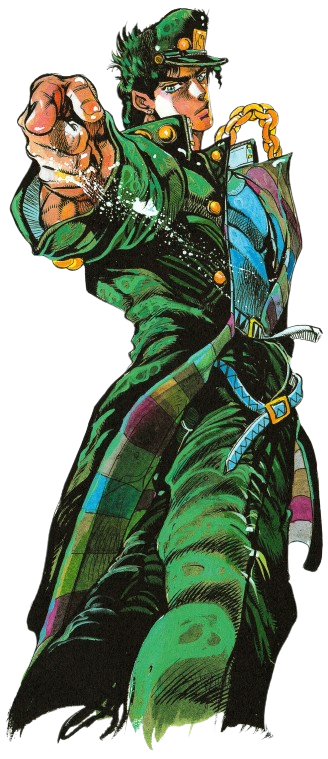
Jojo's Bizarre Adventure Part 3: Stardust Crusaders
Plot Summary of Part 3
My Personal Thoughts on Part 3 Overall
I really like Part 3! Part 3 has Noriaki Kakyoin, for starters, who's one of my favorite characters in the entire series. I think Part 3 has its issues, and it's not my favorite, but I really enjoy it! It's a story that has me giggling throughout it, crying, and then giggling more. What more could you possibly need from a story!
Part 3, to me, has some pretty egregious pacing issues that make it hard for me to get through at times, but ultimately I think a lot of its pacing issues are just slow at worst. At its best we get sequences like everything through the Pet Shop fight to the end of the part, which is quite possibly some of the best action writing in the entire series. I think Jotaro is at his least interesting in Part 3, but that's not to say he's a bad protagonist, just that I find him more interesting following the aftermath of Part 3. The other characters in the Crusaders is what really makes it an interesting part for me, though. Polnareff and Noriaki are characters who are especially interesting to me, anad probably sme of my favorite supporting cast members. The friendships that the Stardust Crusaders form is so dear to me.
My Thoughts on the Manga
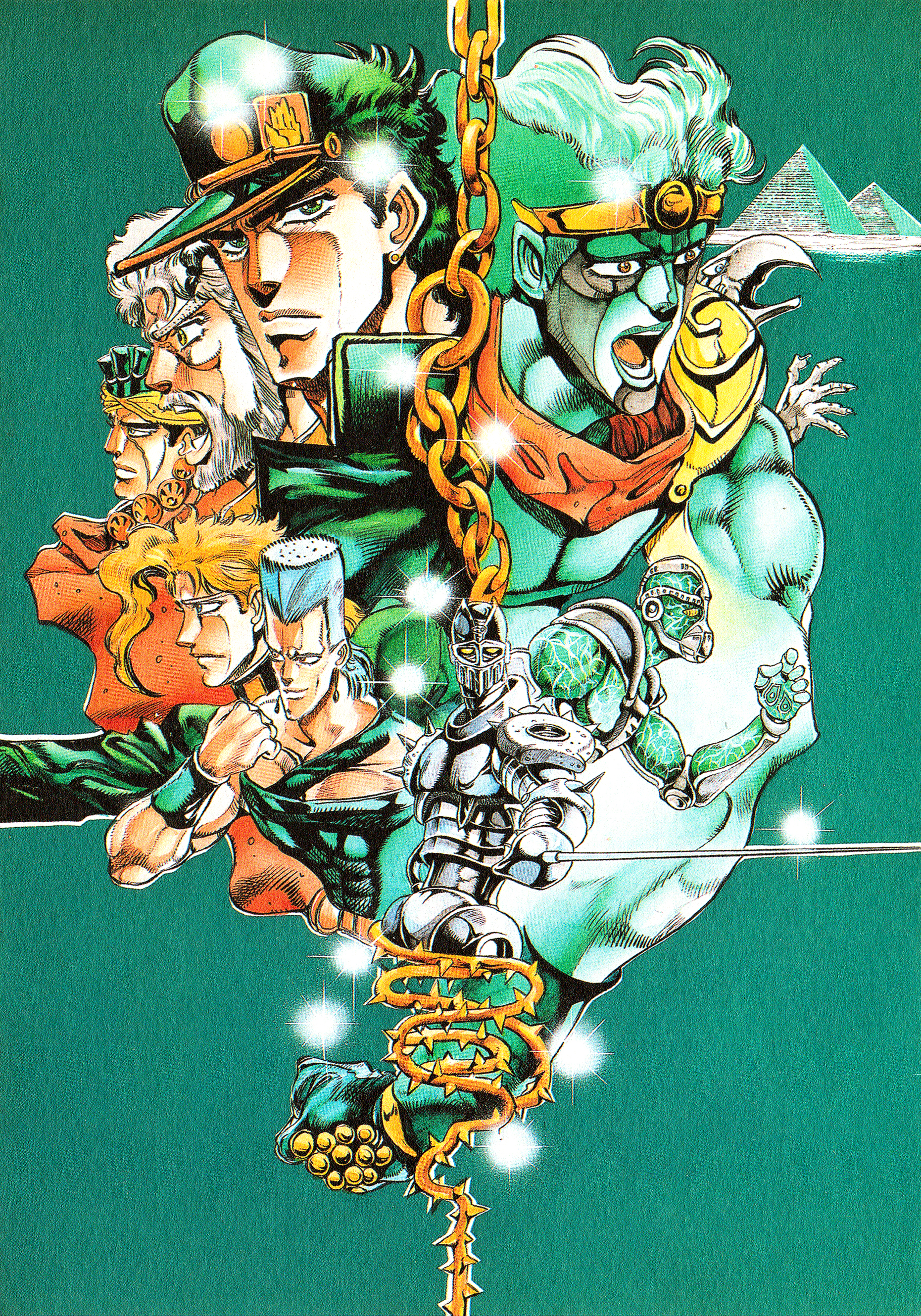
The manga of Part 3 is such a fun romp, basically up until the horrors begin. Both times I've read through the manga, I read through it all in under two weeks. There's something very charming about Part 3 and it's a very endearing read. I enjoy watching Araki figure out what he wants stands to be in real time it makes me laugh. People say later stands are weirder, but SDC has some pretty strange ones. Did we all collectively forget the Wheel of Fortune and Sun stands or something?
I love how Part 3 is colored as well. Everything is so bold and vibrant, it really helps sell the idea that Part 3 is a group of people traveling and experiencing new things. I love how bright it always is.
My Thoughts on the Anime
I think the anime adaptation of Part 3 is kindof dogshit. I don't really like being mean about it but I just really did not enjoy the anime at all. It totally makes sense to me why so many people drop the anime somewhere around Part 3, because it's a pain to watch.
The pacing is the most glaring problem, it feels like a fucking drag to watch because it's 2 seasons long--so over half of the episodes are 2-parters when they absolutely don't need to be. It becomes a really slow watch and kills the momentum Part 3 carries in the manga, and this is only really fixed when they get to DIO's mansion. It's really unfortunate because I think Part 3 has some really interesting stands, but it's hard to want to pay attention on account of how everything feels like it moves at a snail's pace.
I hate how Jotaro looks like a... 40-year-old man. I get that in the manga, Jojo is built like a fucking brick shithouse, but his face stays pretty youthful throughout the series unless he's actively fighting someone or the DIO's mansion. I also dislike how the anime makes Jotaro and Kakyoin so much less expressive... Jotaro is at least excusable, but Kakyoin is a character that is intentionally drawn to have lots of silly expressions, so it makes me sad that people who don't read the manga don't know about the characterization.
At least the episodes with Oingo + Boingo are fun and do something interesting with the material! The bar is underground, but those episodes really clear it. I enjoy it greatly.
My Thoughts on the OVA
As of right now, I have not finished the OVA, but from the 4 or 5 episodes I have seen, I really liked it! I love the art style of the OVA, how it's distinctly original but still retains a lot of the charm of Jojo's, I love how the cast looks in the OVA, everyone's slightly different from the manga counterpart in a way I really enjoy. Star Platinum is so cute in the OVA :). I love Star Platinum.I'll add more when I have seen more!!
Themes of Part 3
By this point, discussing the themes of inheretence within Jojo's seems a bit like beating a dead horse, which is a little funny considering it is only part 3 and this will get referenced again for at least 5 more parts. Sorry!
Themes of inheretance are prevalent in every part of JJBA, but in Part 3, a lot of it feels very pivotal. Jonathan is Jotaro's great-great-grandfather, far enough removed that none of these things should be of any concern to him. At the start of the story, he had no idea who DIO was, had no stakes in this, and yet gets trapped by fate all the same. If it weren't for Holly falling so ill from stand sickness, Jotaro may very well have not ended up on the journey to stop DIO, instead leaving it up to his grandfather. That does not happen, though, because his life is entirely dictated by fate, and fate will create circumstances that force him to confront his inheretance (fighting DIO). Jotaro is a tragedy of a character because he does not have the option to try and outrun fate like Joseph, he can only brace himself for impact and accept it.
Interestingly, I think these themes of inheretance--or more accurately fate--can also be applied to the people around the Joestars as well. Though the hamon-weilding Zeppelis died out with Caesar, stand user companions become the new target of fate in this regard. Much like Ceasar in Part 2, Kakyoin dies in service to Jotaro, helping in the final hours. To know the Joestars is, in many ways, to be trapped within the Joestar curse with them.
Part 3 also focuses a lot of attention on the interconnectedness of the cast being friends, which in turn makes it a story about the people in your life.
Without meeting Jotaro and the others, Kakyoin would have remained lonely and isolated, stuck working for DIO. Even if Kakyoin only got to know friendship and people genuinely understanding him for 50 days, are those 50 days not still important? Was he not changed by finding companionship and community? Kakyoin's growth comes from accepting that he ultiimately has no regrets about joining the Joestar's, that having people in his life who understood him and didn't judge him was the most important thing in the world to him.
And what of Polnareff, who learns to accept the death of his sister, who gets revenge and subsequent closure, through meeting the others? Polnareff's life was undoubtedly improved by meeting Avdol. He goes from borderline suicidal on a mission to get revenge on the person who killed his sister to realizing that people want him to live too, that he needs to think about his own value in the world. Without meeting the other members of the Stardust Crusaders, who knows where Polnareff would be. He was very deeply impacted by the people he grew close to!
This is the theme that interests me the most, because it creates the most interesting parallel between DIO and the Joestars. DIO, ultimately, desires to give themselves a sense of security through controlling the entire universe and eventually ending it, but especially because of their stand The World. Having a stand that stops time in its entirety, one where they believe they are the only ones who can move within that stopped time, becomes a very obvious desire to protect oneself and keep oneself safe.
This is contrasted by the Joestars, who are trying, ultimately, to keep their family safe. Their sense of security is broken multiple times by DIO, first by being brought back from the coffin he was in in the ocean, then by developing stands (Jotaro locking himself away in jail believing to be followed by an evil spirit, thus breaking Jojo's sense of security), and then finally when Holly develops stand sickness and is at risk of dying because her body can't contain her stand power. These things put DIO and the Joestars implicitly against each other in a struggle to create a personal sense of security.
You've all heard of stands as a metaphor for neurodivergence, so obligatory That I Guess.
I feel like anything I say here will just be stating the obvious, but I want to talk about it anyway, because I'm neurodivergent and love reading things as an allegory for being autistic! Sue me!
[MORE HERE]
Jotaro Kujo
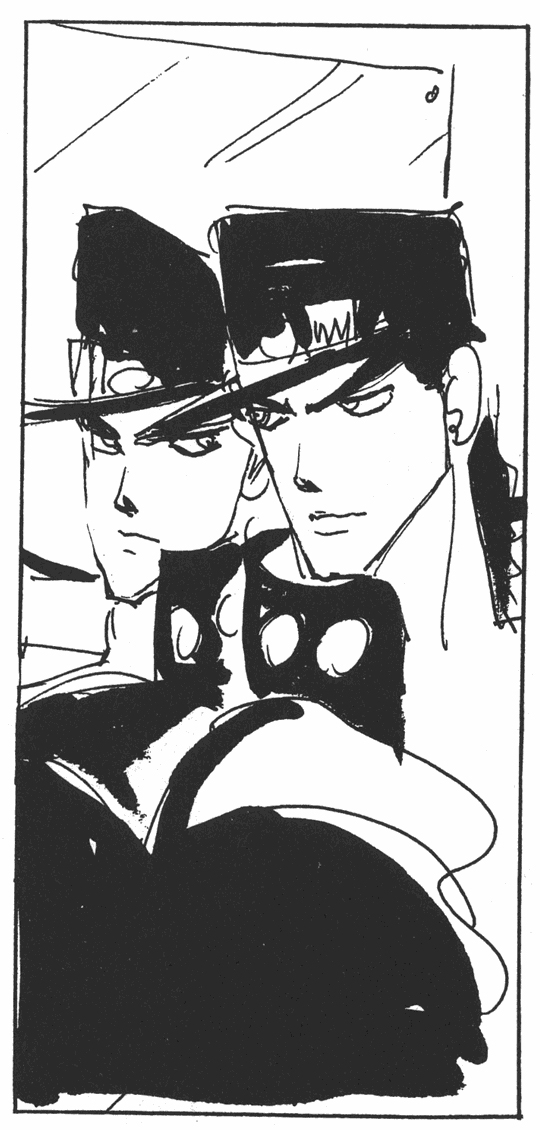
What isn't there to talk about Jotaro Kujo. He's one of the most interesting protagonists of the series to me, in part because we see him from now in Part 3 all the way up until Part 6. For the sake of the continuity of this page though, I'll be talking about him only in Part 3, and doing more synthesis-based analysis part by part
In Part 3, Jotaro is very much just... a 17-year-old. He's someone trying his hardest to look and feel cool to outsiders. He's a character that, at his base, is putting on a kind of performance to appear outwardly to others as what he thinks are cool. He's a delinquent teenager who smokes and shotguns beers because he thinks that's cool. It's painfully 17-years-old of him. I love the detail that he doesn't outwardly express himself much because he believes that others already know what he is thinking. Oh, autistic teen that you are.
The interesting thing about Jotaro to me is that it's very obvious that he cares, and that he cares a Lot. The entire reason he goes on the quest to stop DIO is because he is so worried for his mom, the fact that every time she's mentioned or he hears of her condition he's sweating and nervous. One of the main reasons Jotaro fights so hard in the D'arby fights is because he is so worried for his friends, who's souls could very well just be taken forever. Obviously, Araki has noted that Jotaro simply believes others. can tell what emotions he's feeling so he doesn't express them as "obviously" as others, but I think there's also something to be said about the sort of language Jotaro would even have to express himself.
Jotaro is trying to perform a very stoic style of masculinity--that of the badass hero who says witty one-liners and smokes and drinks. I imagine that it makes it in turn hard for him to show just how much he cares about people, outside of very obvious ways. There's something very endearing about the protagonist being a character who does care so much, but is making himself pretend like he doesn't. Jojo is someone who wants to reach out, to help, to ask if people are okay, but doesn't have the verbal language to do so and thus cares for people the only way he thinks he can: by using his body as both a shield for others and a weapon to protect them.
Joseph Joestar
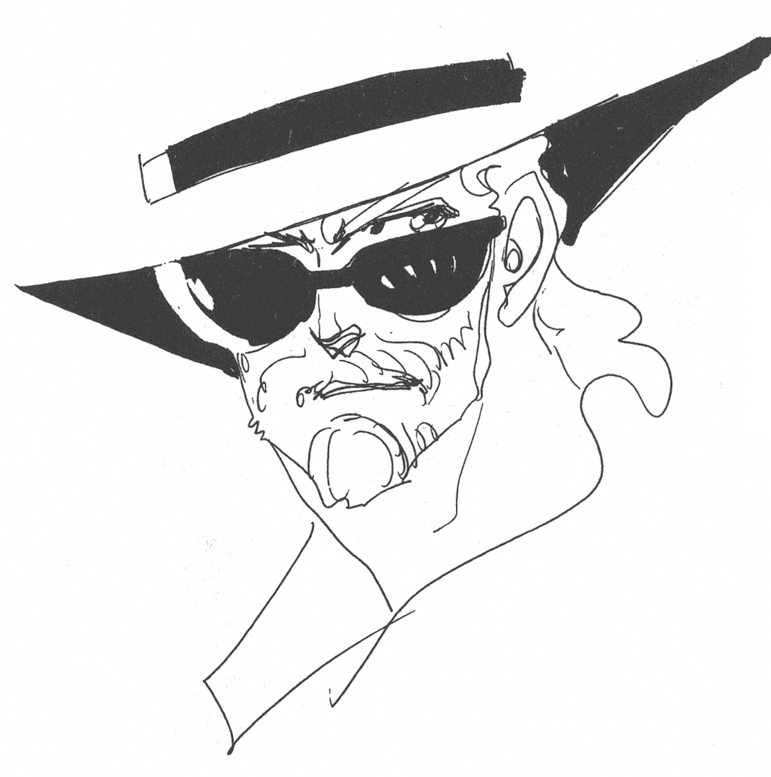
Joseph intrigues me in Part 3 because it feels in a lot of ways like fate has caught up with him. In Part 3, there is nowhere left for him to run, he is instead completely at the whims of DIO's return. Obviously, this feeds into Joseph's internal struggle about not living up to Jonathan's legacy, but more than that, it intrigues me. At one point in Part 3, Joseph mentions how running has only ever been part of the strategy to win for Joseph, but that he can't run now (from the stand they're fighting), and I think this could be interpreted broadly about Part 3 overall. Joseph cannot run anymore because there's nowhere left to run to. Jotaro is taking up the mantle of the Joestar curse, but Jotaro will never be able to run from it, and by Joseph implicating him within it, Joseph can't run either.
Of course, In Part 3, Joseph is still really silly! He's constantly yelling and making :0 faces and such, but I think that the silliness feels a bit... tired? Like, he's acting this way and is so over the top in part because that's who he is, but also in many ways because he feels like it's now the expectation. People expect him to be loud and over the top, and in many ways he is, but he's also trying to pretend that he's not almost 70 here. It's interesting.
Noriaki Kakyoin
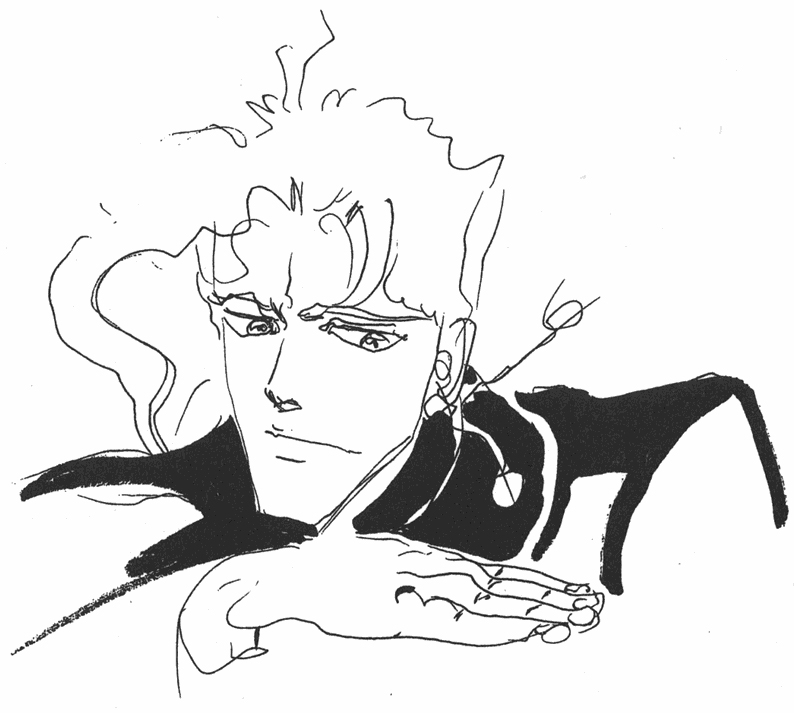
Oh Nori... you make me sick. You are the most lonely autistic 17-year-old ever. He's just really like... someone who was easily manipulated by an adult because DIO saw that Kakyoin was looking for friendship and was able to easily take advantage of that. Everything about Kakyoin makes me feel kindof... sick. I think a lot about how nobody really believed him during the Death 13 fight and how much that had to hurt. I also think about how much everyone being excited to have him back after he got out of the hospital had to feel insane to him, as someone who's never had a group of people care. If you want to see my like... full thoughts on Kakyoin, just check out his page, but yeah. He makes me feel really ill because he's just like... a very relatable teenager who is very lonely. He's very dear to me.
Muhammad Avdol
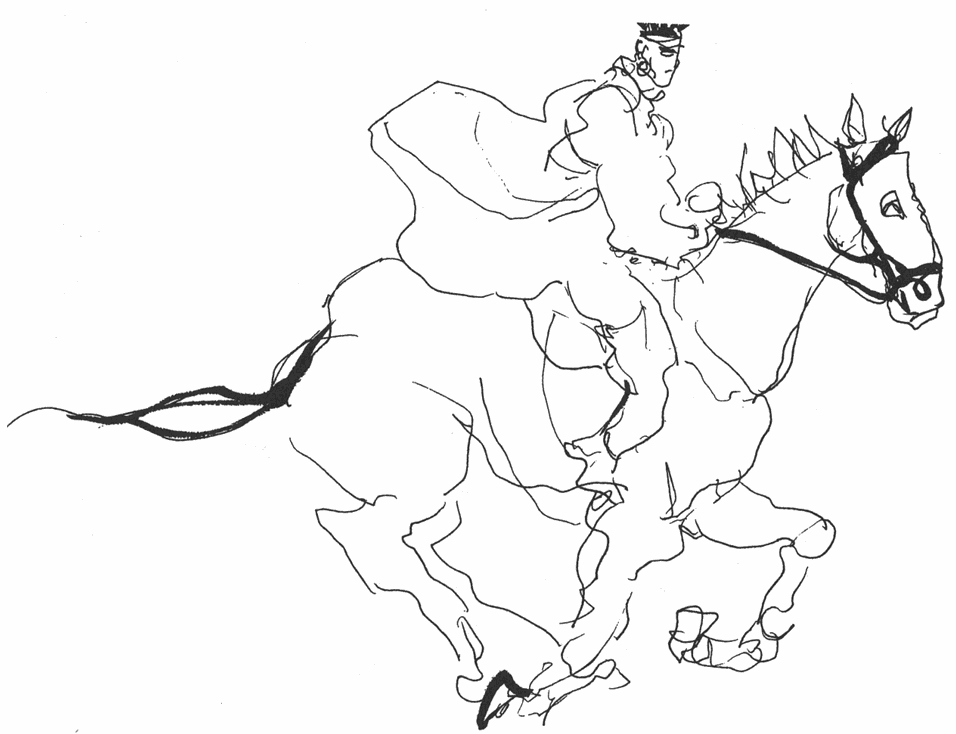
Another one of the fakets idgaf-ers I've ever seen. I'm so fond of characters like Avdol. His role in the group is really interesting because he's a mentor figure, but he's not really that much older than anyone else here, and is still way younger than Joseph (not that Joseph should be counted as a mentor figure oh my god). A lot of his attitude as a mentor comes just from the fact that he knows about stands and has a wealth of knowledge about what other stands there are, not that he's particularly wise.
I think he's an interesting character mostly because of what he does for others. Though he puts upon this cool and mysterious aura, he very clearly cares for everyone in the group. While he sacrifices himself twice in order to say Polnareff, I have no doubt in my mind that he would have done it for any other member of the Stardust Crusaders were it them in that position. Avdol is someone who believes intrinsically that all life is valuable and worth saving, and this means it's hard for him to pretend he does not care. That is ultimately why he sacrifices himself for Polnareff.
I think the way that Avdol focuses on stand sickness is interesting too. It's pretty clear he's seen a lot of people fall ill from stand sickness, and it makes me wonder if Holly's predicament falls close to home for him. This gets into speculative territory, but I think he is at the very least aware of just what kind of suffering stand sickness can bring to people. It's just another way of showing how much he cares.
Jean Pierre Polnareff
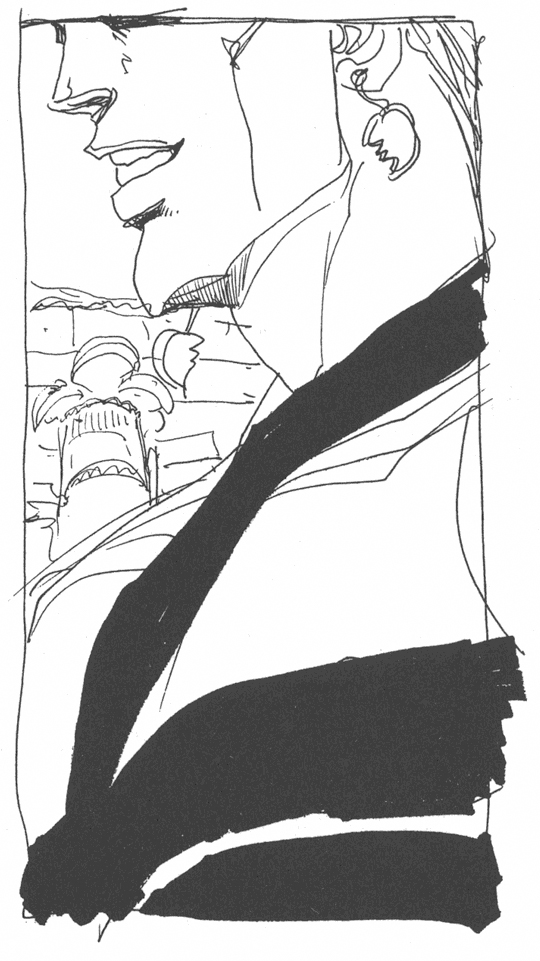
Polnareff kind of makes me crazy because how are you simultaneously a Looney Tunes character and someone I get so upset about if I think about everything in your backstory too long. Like you are a Looney Tunes. You are engaging in Buggs Bunny bits with Hol Horse. And yet. And YET.
Polnareff spends a lot of the story being... not intentionally selfish, but being very self-defeatest in what would best be considered a suicide mission. Going on a revenge quest to kill the man who killed his sister is admirable, but with the way Polnareff acts after the fleshbud is removed, it's pretty clear that he both doesn't care about his own safety and doesn't really see himself as having much reason to continue living after his sister died. That kind of self-blame is really dangerous, and ultimately is what gets Avdol so seriously injured the first time. Him having an entire arc of learning that sometimes you can't prevent people you love dying but you have sto continue living on for them... it makes me sick. Especially because Polnareff wishes so badly that Avdol had survived instead of him.
Holly/Seiko Kujo
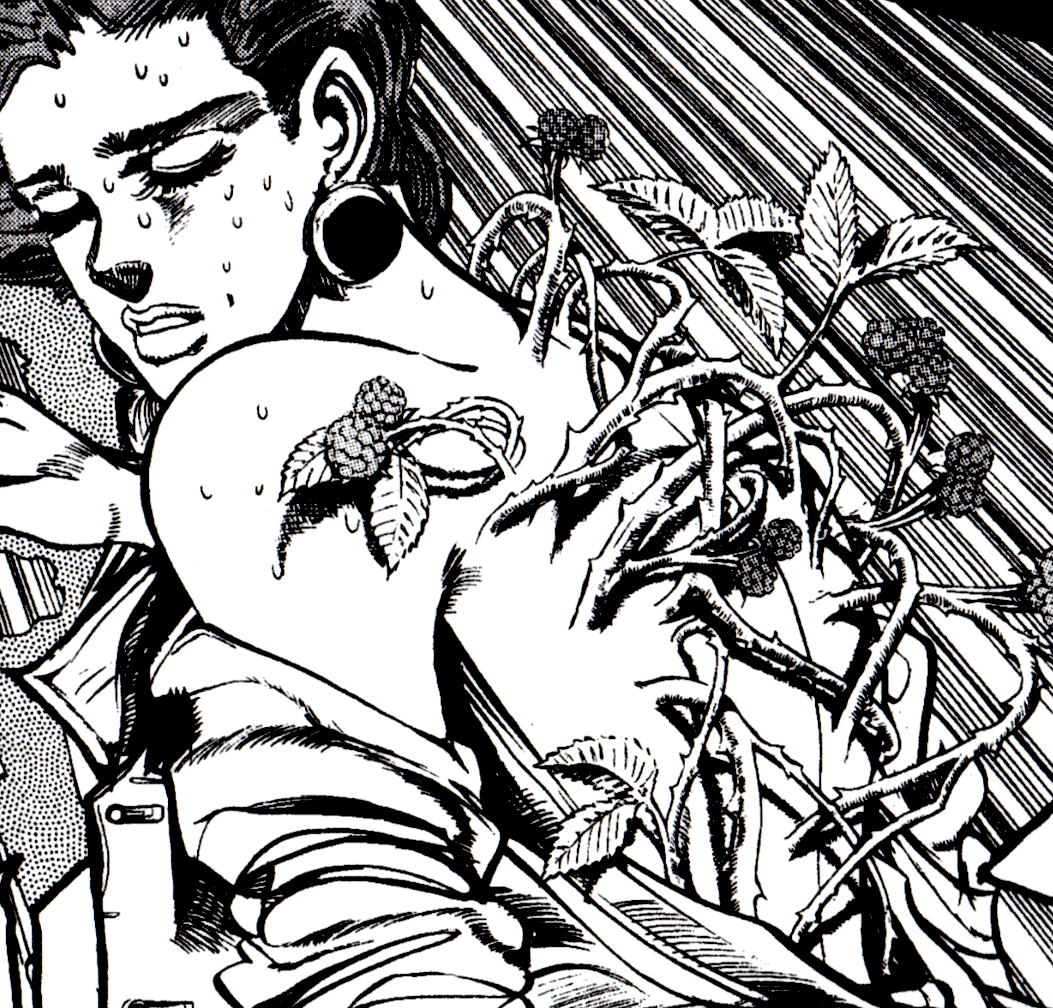
Seiko interests me because as much as she is alive, she is somehow still a ghost haunting the narrative. She spends a majority of her time ill and bedridden, so a lot of her as a character narrative comes from being a goal for the Joestars. Is this the best way to write a woman? No, absolutely not. But I do find it interesting because it turns her into a thematic element. She becomes not only a goal for the Joestars to reach toward, but also a symbol of what the Joestars are looking to protect. Holly is a physical reminder of how their family's safety is under constant threat by DIO, she's a very real reminder that DIO seeks to cause them physical harm. It's so interesting to me.
DIO
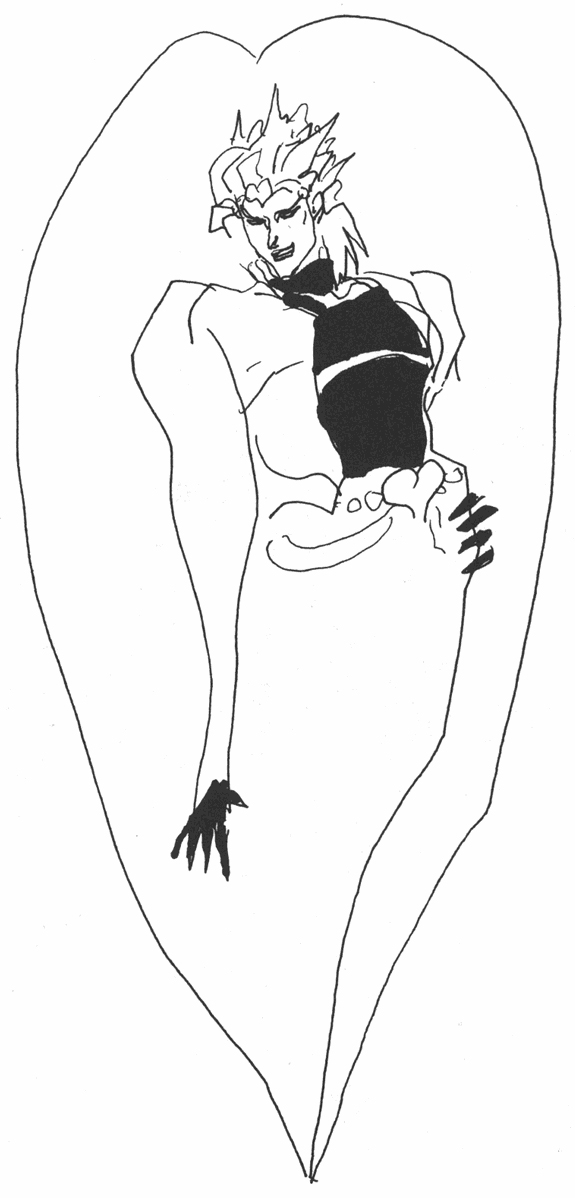
Part 3 DIO is so interesting to me. When I first read Part 3, I thought that he kind of got... more lame? But having now reread it I think he's actually really interesting, I just was really attached to Part 2. I think a lot of what interests me comes from his stand. DIO is somebody who inherently desires safety. Since Part 1 he has been looking out for his own safety because he believed (honestly rightly so) that nobody else cared about it. Having a stand that stops time that only he can move in is ostensibly a guaranteed safety blanket. It's why he's so perturbed at Jotaro possibly moving in stopped time. The Joestars are an inherent threat to his security, and the idea of them moving in a space where only he could do so previously is something that he has a genuine breakdown over. It makes him more interesting in many regards because it's the closest they've ever been to genuinely frightened.
I am also interested in the fact that he turns Vanilla Ice into a vampire. There's very few vampires in Part 3, and I think that is in part because he thinks being one of the sole vampires also gives them a sense of superiority. So to willingly turn Vanilla Ice is of interest to me. Is this all part of my Dionilla agenda? Yes. BUT I AM CORRECT. Dio seeks companionship in someone, as humans are social creatures and DIO was once human, and they offer trust to someone they desire companionship the only way they know how: by giving Vanilla Ice some semblence of that same power they desire for their safety.
Iggy
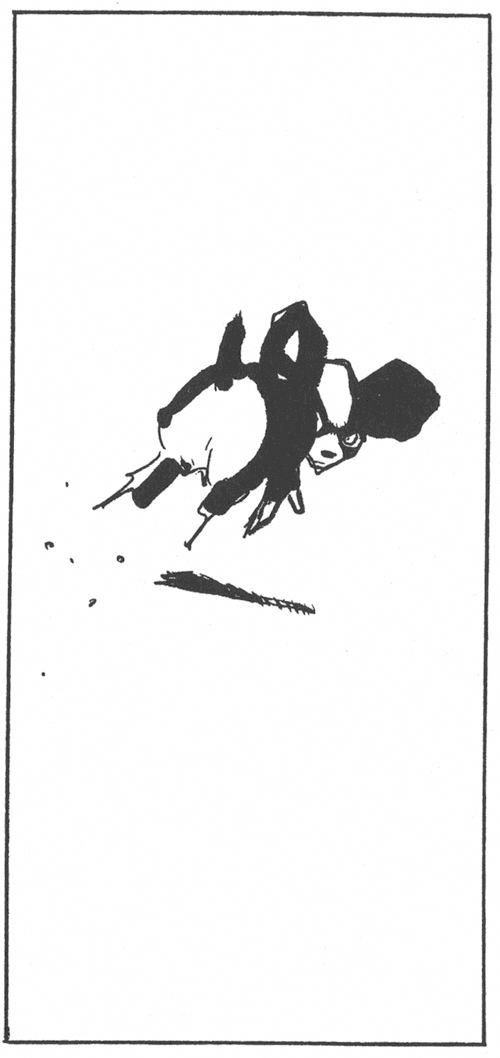
I feel a little silly including him because I just... don't have much to say about Iggy. He's their weird fugly dog that i loathe and love. I genuinely don't think about him outside of the Pet Shop fight because I think that fight is one of the best ones in Part 3. I think he's got a funny internal monologue and as a character he's a bit silly but I just can't find anything right now to say about him. Dog that just wants to settle down with a nice girl? Fuckin' yeah, okay. I don't get why Iggy sacrificed himself for Polnareff either lowkey. Maybe I have to reread the Vanilla Ice fight because there's something I missed but IDFK.